
Find Andover Residents by Record
No single open list names every Andover resident. Different custodians hold different facts. The Patriot Properties assessor search is the best opening move when an address or assessed owner is known. The Essex North Registry search follows a legal transfer. Memorial Hall Library is the stronger route for an old Andover name, a landmark address, or a past community connection. A state voter form confirms one named person's registration only after every required identifying field is supplied.
Start with a question, not a broad name search. A parcel question calls for the assessor and GIS. A title question points to a deed, book and page, or plan. A historic-address question belongs with directories, street lists, maps, and newspaper scans. A name match is only a lead. It stays a lead until another field agrees, such as a middle initial, a date, a parcel, a street variant, or a family connection. An assessed owner may not live at the location. Many Andover residents never appear in land records at all.
- Enter a street or owner name in Patriot Properties and save the parcel ID, location, assessed owner, sale field, and book/page field.
- Use the Town GIS viewer to put the parcel in context, including nearby parcels and public map layers.
- Search the Essex North index by owner, address, or book/page to identify a recorded transfer and its legal description.
- For a historical person or address, check the corresponding Memorial Hall Library directory and street-list years before assuming a modern number existed.
- When a named record is absent online, send the responsible custodian a narrow request with a record type and date range.
Andover Resident Record Desks
Andover splits its resident records across several desks. The Town Clerk holds the vital records, election files, and annual census and street-list material. Business certificates and general town records sit there too. Land records live elsewhere entirely. Andover sits in the Northern Essex District. Deeds and parcel documents are handled from Lawrence rather than the Salem Registry. The Assessor and the county GIS tools carry the current parcel layer. For history, Memorial Hall Library is the stop that matters. Its shelves hold old city directory volumes, street lists, maps, yearbooks, and local newspapers.
One link belongs in every lookup. The Town's Public Records Center works well when an online portal returns no result or no image. It names the Records Access Officer who handles each type of request. It also spells out how to frame a focused records request properly. Just remember the limit. That path covers records the Town already holds. It is not a custom resident list built to order.
The Andover Public Records Center is the source displayed here. Its request route helps separate a true municipal-record question from one that belongs with the Registry of Deeds, a court clerk, or the library. Knowing which desk owns the record saves real time.
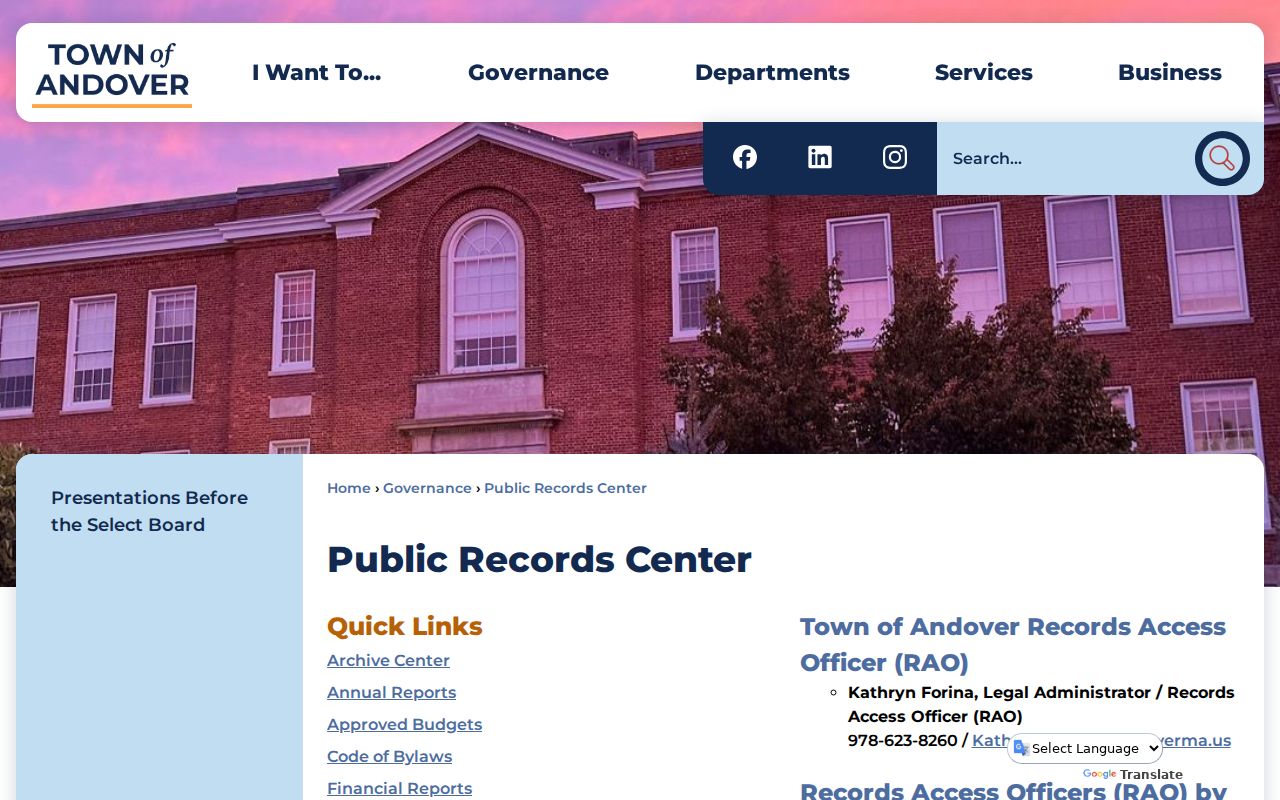
Use the office named for the record series. Describe the address, date range, and format. That detail cuts avoidable delays and makes it easier for an Andover custodian to locate an existing file.
Essex North Registry
1 Union Street, Suite 402
Lawrence, MA 01840
978-557-1900
Choose the Andover Record Route
A present-day property question starts with the assessor. The GIS map then separates the location, the parcel boundary, and nearby public layers. For an ownership change, carry the assessor book/page into the Registry index. A Registry document is an index and a recorded instrument. It does not say a named person occupies the place now. The record may sit under a trust, an estate, or a corporation. It may sit under initials or a spelling variant.
Massachusetts tools for people without property are purpose-specific. The voter form checks one registration. Name, birth date, and ZIP must already be known. MassCourts searches public case records under court access rules. The state vital index covers historical records. A certificate, though, follows different access rules. For a former classmate or an old family address, Andover directories, yearbooks, and newspapers beat any current portal. Local-history collections at Memorial Hall Library do too.
Andover Patriot Search Fields
The Andover Patriot Properties form is an optional-filter search. It is not a person directory. Enter one street, an owner name, a parcel ID, or property characteristics. Combining a street name and number narrows the result. A blank search tends to mix municipal land, commercial parcels, condominiums, and other property types, with simple Go and Clear form controls.
| Patriot field group | How the portal uses it |
|---|---|
| Parcel, Owner | Optional exact property identifier or assessed-owner search. |
| Street Name, Street Number | Address route; street-only searching is broader. |
| Building Type, Year Built, Beds, Baths | Optional characteristic ranges for narrowing a parcel set. |
| Finished Size, LUC, Neighborhood, Lot Size | Optional land-use and physical-property filters. |
| Total Value, Sale Price, Sale Date | Optional assessment and transaction-date ranges. |
| Book and Page | Bridge field for checking a recorded instrument at Essex North. |
The Patriot assessor search returns sortable, paged results. Columns include parcel ID, location, owner, type, total value, beds and baths, lot or finished area, land use, neighborhood, a sale field, and book/page. Together they tie each row to a recorded deed.
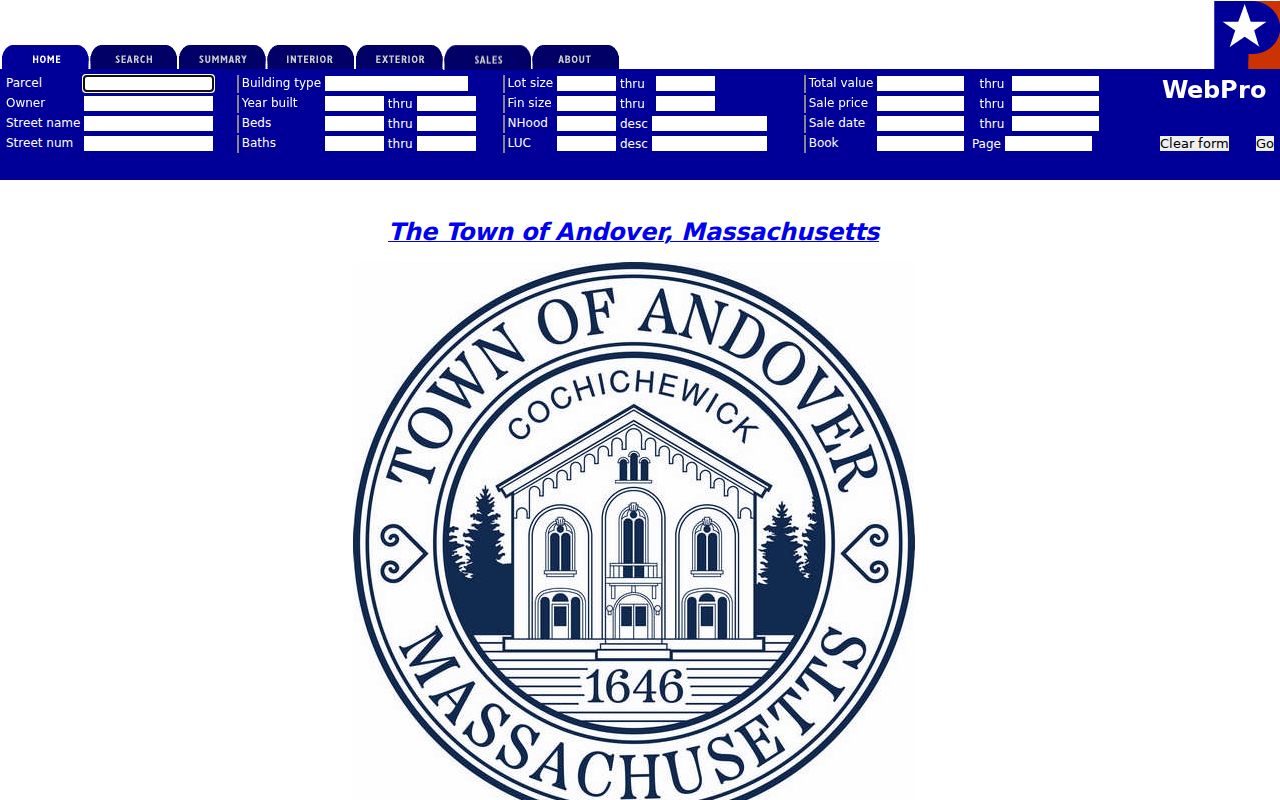
Save the parcel ID and book/page first. Those stable references connect portals far more reliably than matching a common Andover name across unrelated results.
Andover Owners Are Not Residents
A parcel result names the assessed owner, not the occupant. The assessor may list a mailing address in another town entirely. Owners can also be trusts, estates, institutions, or businesses. The Andover Town GIS adds parcel, easement, zoning, wetland, district, and abutter context. Those boundaries are informational. They are not a legal survey. Any name surfacing in either system still needs an independent check.
- Situs address
- The physical location attached to a parcel record.
- Mailing address
- The address used by the assessed owner for correspondence. It may differ from the situs.
- Parcel ID
- The assessor's property identifier, such as the spaced format used in Andover. It ties a search to a specific assessment record.
- Abutter
- An adjacent parcel in a map or plan context. An abutting owner is not proof of a resident relationship.
Once a parcel is identified, the Town GIS viewer and library becomes the natural next stop. The Town describes map queries there. Property-history and abutter functions add context around a parcel. Treat the pieces separately. An owner name, a physical location, and a legal document are distinct fields. None of them alone counts as a household record.
Essex North Andover Deed Trails
Andover deeds are recorded at Essex North in Lawrence. The Southern Essex Registry in Salem holds a different set. For online work, Essex North offers recorded-land search by name and address, plus book and page, year, instrument, and entry date. Land Court records, plans, and scanned indexes each have their own search modes. Scanned grantor and grantee indexes cover 1869 through 1979. Later recorded-land material works better with the structured date modes. For earlier Andover deeds, follow the Salem historical path that Memorial Hall Library identifies.
A grantor gives up an interest. A grantee receives one. Trace an address backward through both roles. Begin with the assessed owner and the book and page, open the instrument, and note the legal description plus any prior reference. Then search that earlier owner. Addresses can still fail, since a deed may cite a lot, a plan, a historic name, or a larger tract.
The Essex North recorded-land index appears below. Website copies are free, the Registry says, and it warns owners about solicitation letters charging for deed copies.
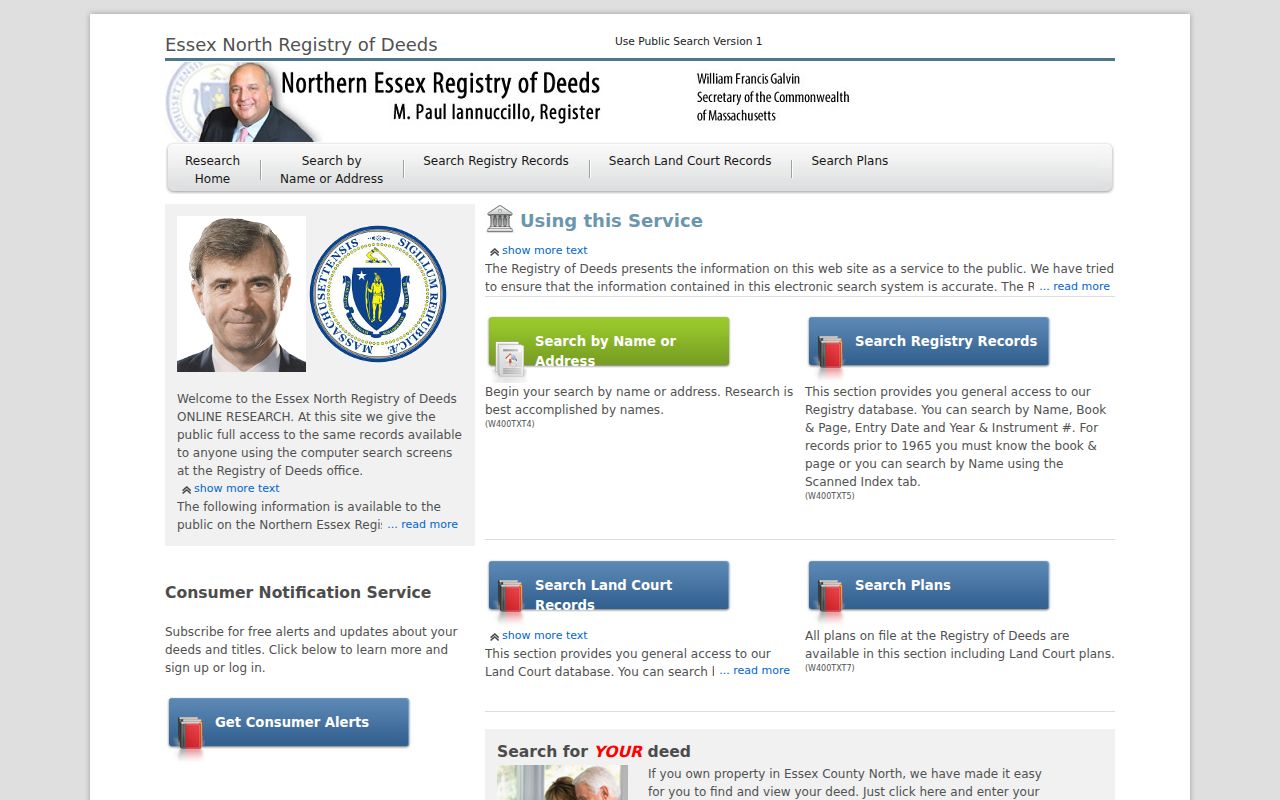
A deed fixes a legal transfer date and names the parties to it. That is its strength. It cannot show who occupies the address now, confirm identity beyond the document, or list every person tied to a property.
Current Andover Resident Sources
Treat current sources as separate record sets. They are not one directory. Property records answer assessed-ownership and parcel questions. Deed indexes name the parties to a legal transfer. The voter form confirms one individual rather than browsing a street, and Andover's annual census and older street lists add a time-specific local layer, subject to access rules. Match each question to the right source.
| Andover source | Primary record scope | Custodian | Access boundary |
|---|---|---|---|
| Patriot assessor record | Assessed owner, parcel, situs, characteristics, sale/book-page fields | Town Assessor | Public web search; informational, not occupancy or title proof |
| Essex North recorded-land index | Grantor, grantee, instrument, recording date, town, book/page, plans | Essex North Registry | Public index and copy path; a legal-record trail |
| Voter Registration Search | Individual registration confirmation with supplied name, birth date, and ZIP | Secretary of the Commonwealth | Individual lookup; no public address-list browsing |
| Annual census and street lists | Town-reported residents in a particular year | Town Clerk and MHL | Request or reference access; inclusion rules vary |
| Town directory | Municipal department contact routing | Town of Andover | Public contact source, not a resident roll |
Pair each question with its record. Use an assessed-owner name to open a property and title trail. Use a full name with birth date and ZIP for an individual voter confirmation. A date and historical address suit library material. The Andover resident lookup adds a name-by-name sequence across public court, vital, business, and historical sources.
Andover Voter Check Fields
The Massachusetts Voter Registration Search works one person at a time. You enter a specific individual's details, and it returns a match or a non-match. It does not produce a public list of names by street or ZIP. State law limits the central registry under M.G.L. c.51 §47C. So an apparent non-match proves nothing about whether someone still lives in Andover. Protected addresses can block a result. A mismatch in name, birth date, or ZIP can block it too, all without any change in residency.
| State form field | Format and purpose |
|---|---|
| First Name and Last Name | Required text fields; use the registered spelling. |
| Date of Birth | Required month, day, and year dropdowns. |
| Residential ZIP Code | Required five-digit field; it is not a mailing ZIP field. |
| Agreement | Required acknowledgment that the query is intended for an individual voter. |
| Search and Reset | Search submits the individual query; reset clears the form. |
The state voter confirmation form displays a fixed message when nothing matches: “Voter Registration Information Not Found.” That wording carries no conclusions. It is not a record of a move, a death, or any lost connection to Andover.
The Town Clerk handles registration questions and can explain local procedures. Treat the public form as an individual confirmation tool only, never as a way to assemble a block or street roster for Andover.
Andover Registration Counts
Andover's 2025 Annual Town Report offers useful scale without naming any voter. It counts 26,564 registered voters at year end. Of those, 21,615 are active and 4,949 inactive. Another 1,357 new registrations were added during the year. The report also lists ten precincts and one sub-precinct. They are run with electronic poll books and high-speed tabulation. These figures describe election administration, not a searchable residents list.
Inactive status deserves caution too. The annual-census notice warns that two consecutive nonresponses can affect active-list standing. That administrative label alone says nothing definite about where a person lives now. Confirm a particular individual through an official individual check. Do so only when the required fields and purpose fit. Then corroborate any result with an independent record before drawing a conclusion.
Andover Court Name Searches
The MassCourts public search lets anyone look up public cases by name, department, division, location, case type, date range, case number, or ticket number. A name search starts with a last name. Published instructions include a public-record entry step. Each result can list party role, case number, court, status, scheduled events, and a disposition where public. The clerk or register keeps the official file. That office remains the authority on any case.
Andover matters may sit in Lawrence District Court, Lawrence Probate and Family Court, Essex Superior Court in Lawrence, or another court chosen by case type. Juvenile, sealed, impounded, adoption, and redacted material stays off limits. Common surnames need care. Tie a hit to an Andover person only with a case number, party role, date, or another lawful cross-check. Draw conclusions after that.
The MassCourts public-record entry point appears on the official page. The live system sometimes asks for a quick verification before a search runs.
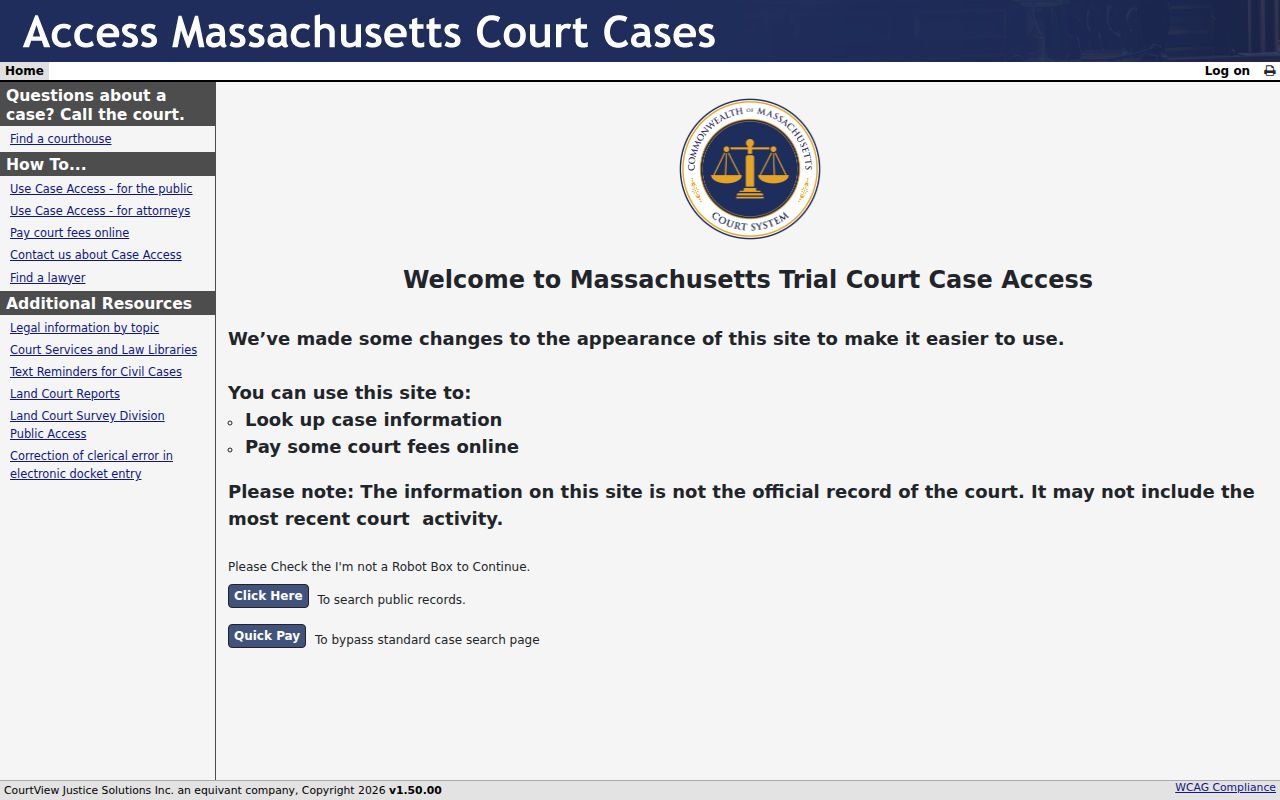
A public docket never tells a person's whole story. It also cannot replace the official file, so ask the appropriate clerk for a case number, a copy, or any access limitation before relying on it.
Lawful Andover Record Use
Public access has limits. Massachusetts restricts statewide voter address data, and court files can be sealed or impounded. Vital records carry eligibility rules. The Address Confidentiality Program can substitute a safe address for an eligible participant. It keeps the real one protected. An owner mailing address, a newspaper mention from years past, or an index hit should never be used to expose a protected location. It should also never be used to contact someone again and again.
Safety comes first for some records. The Massachusetts Address Confidentiality Program serves qualifying people facing defined safety threats. It works by substituting a designated address in covered public-record uses. The protection is not retroactive. A records trail never becomes a license to dig up prior address information. Questions about a restricted record belong with the official source. The custodian who holds it should answer them.
Andover Public-Record Requests
Precision makes a records request work. When a Town-held record is not online, name the record series. Include the address or parcel and the date interval. Add the preferred electronic format. Say whether inspection or a copy is wanted. For older material, list street-name variants and the probable collection or year. A targeted request for a permit log, a named street-list year, or a parcel-specific record beats a request for everything.
Andover's published process follows the Massachusetts Public Records Law, M.G.L. c.66 §10. It calls for acknowledgment or a response within ten business days. An itemized good-faith estimate arrives when fees apply. The Town lists 5 cents per black-and-white page. It adds actual postage. It caps the labor rate at $25 per hour, subject to the municipal first-hours rule and possible waivers. An agency need not create a new record or answer a research question.
A custodian's targeted record and a commercial people-finder category are different things. The comparison below keeps them apart. That distinction matters most when names are common or an address has changed.
| Official custodian record | Commercial people-finder category |
|---|---|
| Identifies the keeper, record type, date, and stated access boundary. | May combine public records, broker data, and old marketing or address information. |
| Can be checked against the original index, image, clerk, assessor, or library collection. | May be incomplete, stale, or combine people with the same name. |
| Answers a limited record question, such as a recorded transfer or assessed owner. | Should be treated only as an unverified lead and used lawfully. |
Town records have a home base. Use the Andover Public Records Center or its request form for anything the Town holds. Court and vital materials run through their own clerk or registry process, so a general request cannot substitute when a specialized access rule controls.
Andover Vital Record Boundaries
The Town Clerk issues local copies within clear limits. Qualifying copies cover births occurring in Andover and Massachusetts births tied to an Andover-resident mother, marriages with intentions filed in Andover, and deaths in Andover or elsewhere in Massachusetts when the decedent was an Andover resident. The Town lists a $10 local certified-copy fee. An event outside that jurisdiction may still sit with another local or state custodian.
Statewide records split by era. Massachusetts Archives holds vital records for 1841 through 1935, and its online index searches 1841 through 1910. RVRS serves later statewide records. An index citation is not a certified copy, and eligibility rules still apply. Published state guidance sets historical thresholds of more than 90 years for birth or marriage records and more than 50 years for death records outside the special identity restriction. Confirm current rules before ordering.
The Andover vital-records page is shown below. It routes a requester to the Town path or the state path according to the event and the connection to Andover.
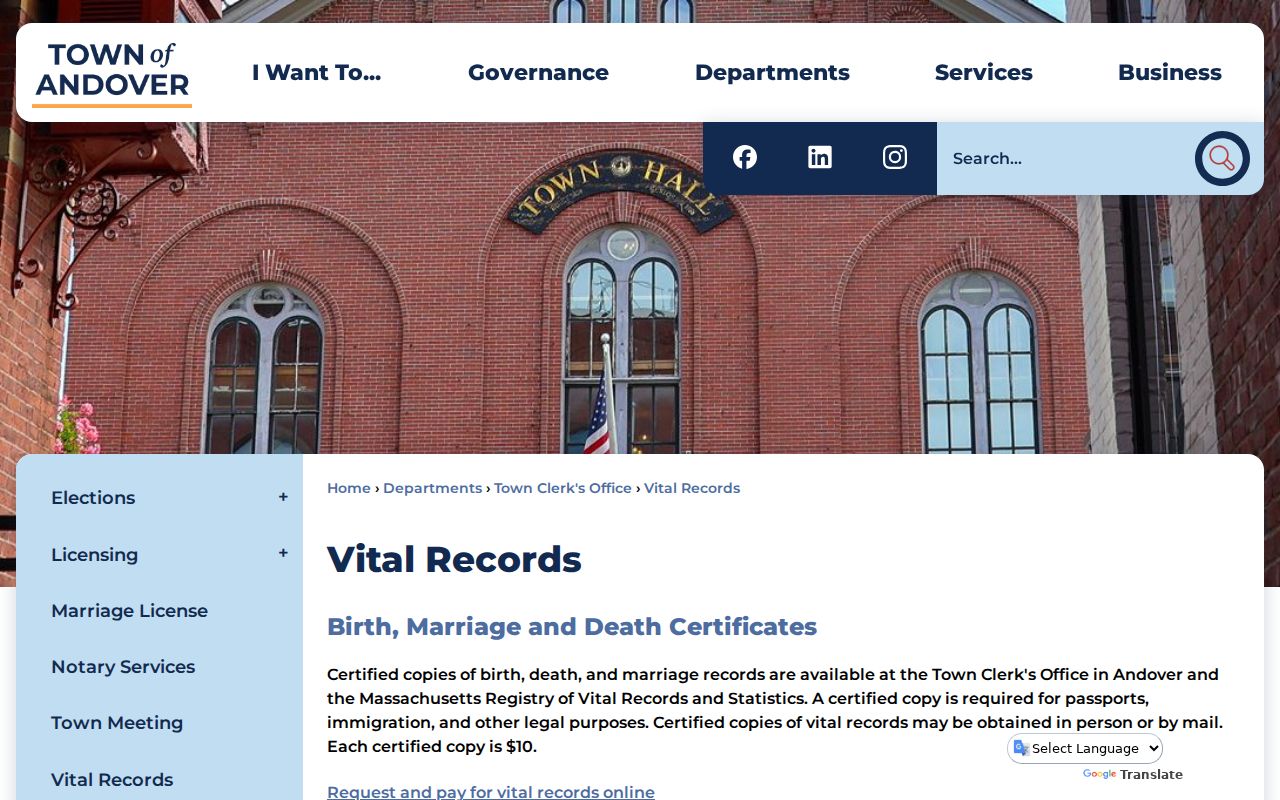
Vital records confirm an event when the right custodian and access path are used. They are not a current address directory, and an index result alone does not establish identity.
Historical Andover Resident Directories
Memorial Hall Library's digital collections gather a remarkable range of Andover material. The holdings link Andover and North Andover directories, Townsman directories, assessors' street lists, vital material through 1849, maps, yearbooks, and local newspapers. The directory run includes 1893-94, 1897-98, 1913, 1916-20, 1923, 1926, 1928-32, and selected odd years from 1935 through 1953. Street-list runs cover 1925, 1926, 1931, 1934, and later Board of Registrars runs through 1988. These serve as date markers rather than a continuous annual sequence.
The 1893-94 Andover and North Andover directory rewards patience. An entry may list a name, a relationship notation, a street or landmark, and local context. A street can be a corner, a nearby school, a mill, or a village district rather than a modern number. Read the page image whenever OCR wavers. The Andover city directory gives the fuller collection-by-collection route.
Andover Street Names Over Time
Andover's addresses changed shape twice. Memorial Hall Library's house-history guide records street names adopted in 1905. Mineral Street became Red Spring Road, and Green Street became Morton Street. Most houses were renumbered in 1959, especially in West Andover. The guide maps former number 183 Argilla to number 93 after renumbering. A modern address-only search can miss a real historical chain.
Bridging the gap takes layered sources. Use the directory street section, maps, deed plans, legal descriptions, nearby landmarks, and owner names. Search the assessor parcel, then check deed book and page references along with historic variants. A deed may say "formerly known as." A directory can point to a school, corner, village, or estate. Record the old and current forms together. Don't force an older address into a modern format.
Andover Cemetery and Newspaper Trails
Research can continue past the directory trail. Spring Grove Cemetery offers a municipal GIS-based lot search, a map, and rules. The Town's Veterans' Services keeps a separate graves-registration role. Memorial Hall Library's new historical-newspaper platform supports keyword and date searching, clipping, and saving. It covers about 170 years of local coverage. Obituary, probate, marriage, address-variant, and community notices can test a time-specific connection.
The Spring Grove Cemetery page is shown below. It links the municipal lot-search route and map rather than a conventional open name index.
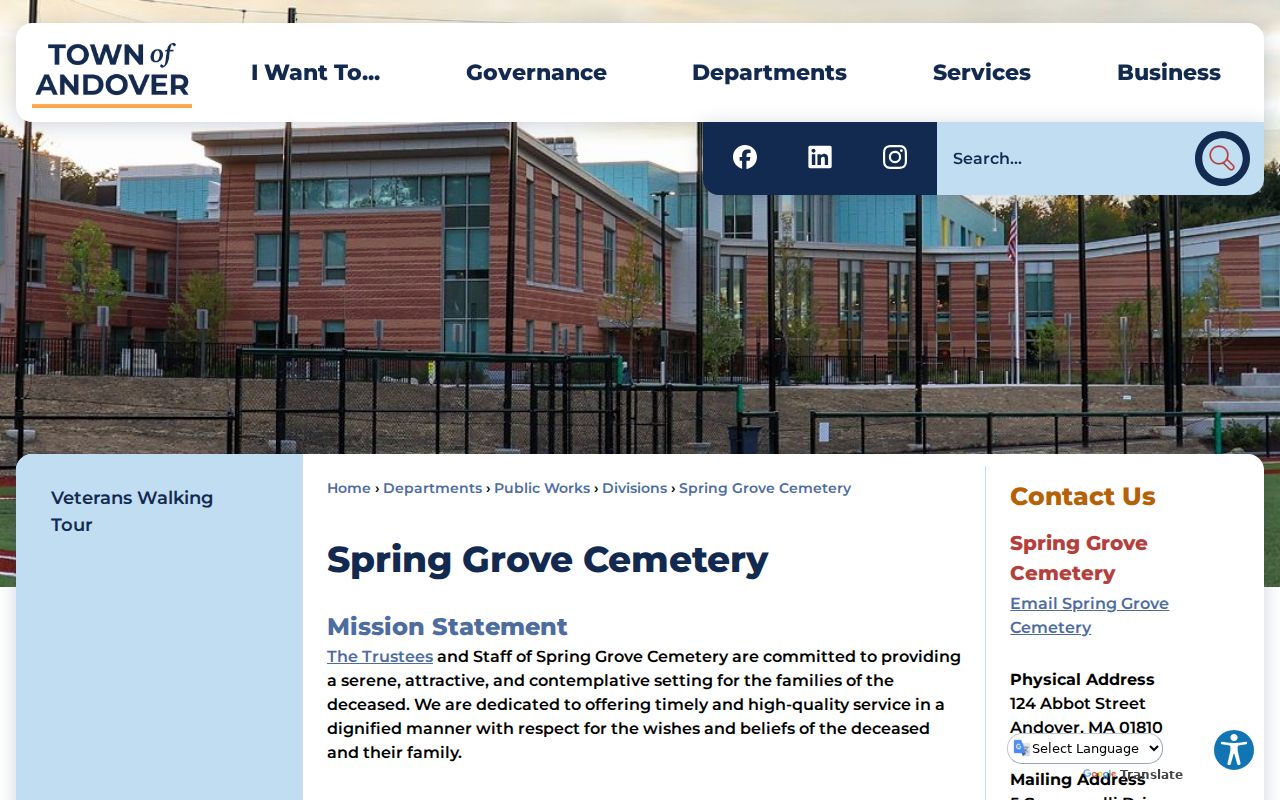
A burial notice or newspaper hit is a lead, not a verdict. Pair every cemetery or newspaper result with a directory year, a vital record, a deed, or a probate file before you settle on where a family lived. Memorial Hall Library's newspaper results are historical evidence, and their OCR and coverage limits mean a missing hit never proves someone skipped town.